
Science of Reading: Silver Bullet or Fool’s Gold

“If you repeat a lie often enough it becomes truth”
By Paul Thomas
Journalists and politicians are both drawn to and depend on compelling stories.
Regretfully, whether or not those stories are factually true is less and less important, and in some cases, what makes the stories compelling is over-simplification while the truth is complicated or often not clearly defined.
The stories told about education have a long history of being trapped in compelling but false claims. Currently, the most popular and compelling education story is about reading proficiency among US students; this story is grounded in a very compelling story about reading reform in Mississippi, identified as reform labeled the “science of reading.”
The repetition of the so-called Mississippi “miracle” has occurred dozens of times since 2019—and here are just two of the most recent:
- Rahm Emanuel on Twitter:
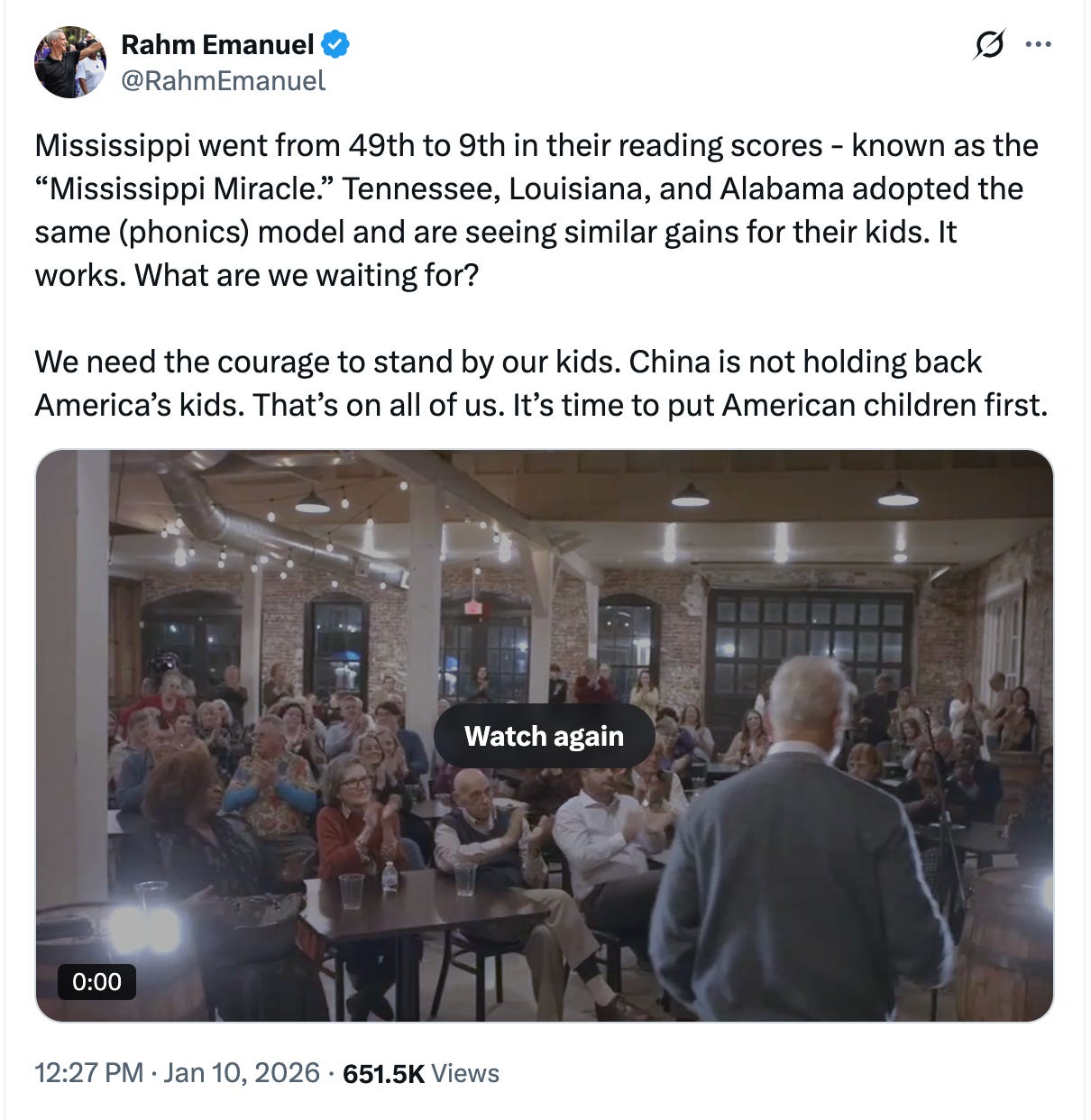
- And yet another article in The New York Times: How Mississippi Transformed Its Schools From Worst to Best
Everything about the Mississippi story fits perfectly into the larger stories that Americans love.
So there is now a recurring accusatory question: If high-poverty poverty state with a large proportion of Black students can radically improve reading proficiency among their students, why don’t all states adopt that policy?
From that, it gets uglier because the implication and direct accusations that follow are damning: The education establishment, bolstered by teachers unions, simply don’t think poor and Black students can learn; the education establishment uses poverty as an excuse and will not let go of the soft bigotry of low expectations.
Throughout the stories being told about reading, teachers, and education, there is a discouraging pattern: The stories are not supported by the evidence (ironically, the stories behind the “science of reading” lack scientific research), and in many cases, the evidence contradicts the story being told.
Continue reading here.

Reading Kingdom is an online K-3 reading program that uses a new “phonics-plus” model to teach students to read and write at a 3rd grade level with comprehension. Sign up for a complimentary Reading Kingdom trial (or any of our other products) here.
We also have a program for students on the autism spectrum and others who face unique learning challenges called ASD Reading. Sign up for a complimentary trial of ASD Reading.
State & Charter school funding is available! Look for your program and begin using your education funds today!
Want to help a child in need learn to read? Try shopping at our Amazon affiliate store where a portion of every sale goes towards teaching kids the life-changing skill of reading.

